SiFive Hiring Freshers 2026 | System Validation Engineer (New Grads) | Bengaluru
Introduction
Are you a recent engineering graduate interested in processors, embedded systems, computer architecture, and hardware-software integration? SiFive is offering an opportunity for new graduates to begin their engineering careers as a System Validation Engineer. The role is particularly relevant for candidates who want hands-on exposure to RISC-V processor technology and system-level validation.
SiFive is a major contributor to the RISC-V ecosystem and develops customizable processor and related IP for applications spanning AI, automotive, data centers, mobile, IoT, and other computing markets.
Job Title: System Validation Engineer – New Grads
Company: SiFive
Experience: New graduates / entry level
Job Type: Full-time
Job Requisition: R-101316
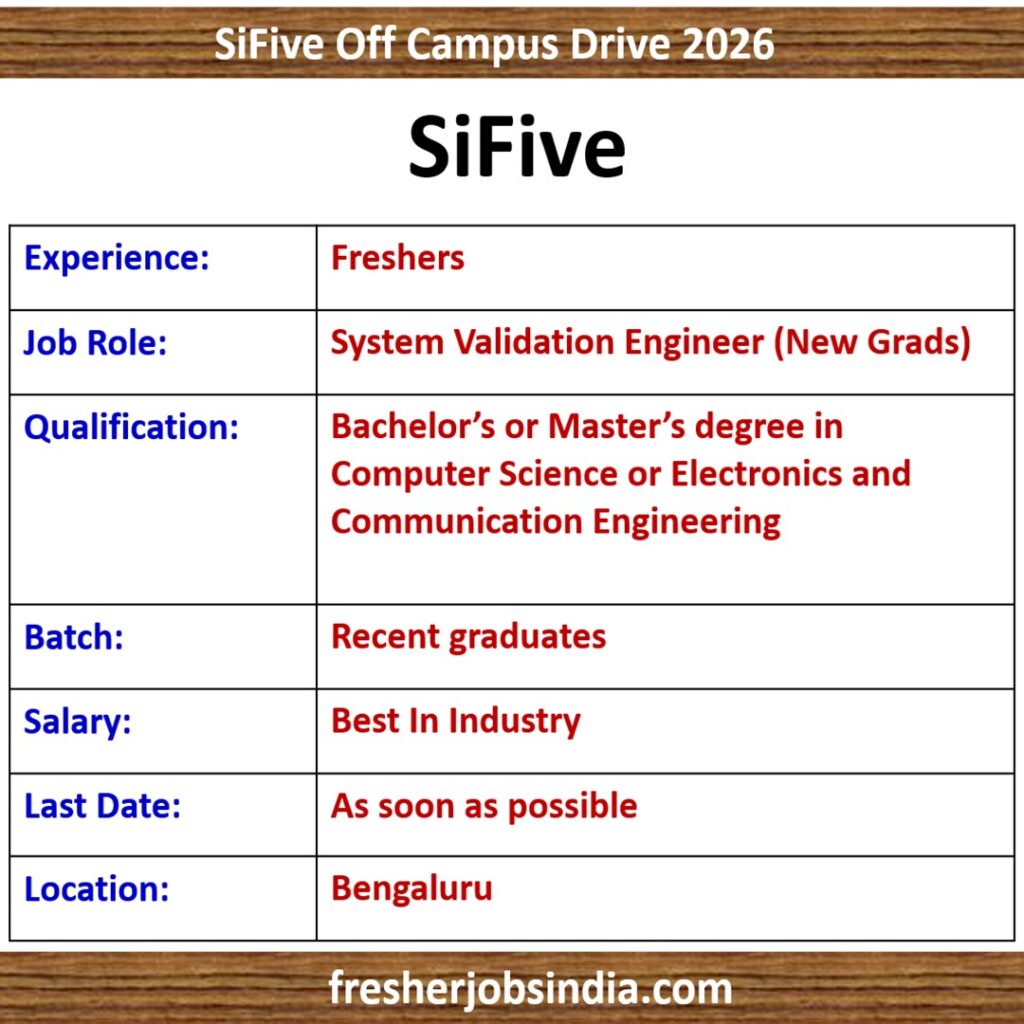
1) Job Summary
The System Validation Engineer role is designed for engineers starting their careers in processor and system validation. As part of SiFive’s CoreIP engineering organization, the position involves working with RISC-V-based processor technology and helping identify, reproduce, analyze, and resolve system-level issues.
System validation sits at the intersection of hardware and software. Depending on the project, engineers may work with processor cores, SoCs, FPGA environments, boot software, operating systems, development boards, test infrastructure, and debugging tools.
This is therefore a suitable opportunity for graduates who enjoy understanding how hardware and software interact rather than focusing exclusively on one layer of a system.
2) Job Description
A System Validation Engineer can expect to contribute to activities such as:
- Validating RISC-V processor and system functionality.
- Running and analyzing system-level tests and regression suites.
- Investigating failures and helping identify their root causes.
- Working with hardware and software teams during debugging.
- Reproducing issues in appropriate development or FPGA environments.
- Testing processor functionality with bare-metal and Linux-based workloads.
- Analyzing logs, test results, and system behavior to identify potential problems.
- Documenting failures clearly and communicating findings to relevant engineering teams.
- Supporting validation infrastructure and automation.
- Learning and applying system-debugging methodologies across processor, SoC, firmware, operating-system, and board environments.
Related SiFive system-validation roles describe responsibilities involving root-cause analysis across processors, SoCs, bootloaders, Linux kernels, boards, and tools, as well as collaboration with FPGA and system-software teams.
For a new graduate, the emphasis is likely to be on technical fundamentals, problem-solving ability, willingness to learn, and the ability to understand complex systems.
3) Eligibility Criteria
Candidates should carefully review the live posting for the exact educational and role-specific requirements before applying. For this type of graduate system-validation position, relevant academic backgrounds can include:
- Computer Engineering
- Computer Science
- Electrical/Electronics and Communication Engineering
- Electronics Engineering
- Related engineering disciplines
Useful technical knowledge includes computer architecture, operating systems, embedded systems, C/C++ programming, Linux, scripting, digital systems, and processor fundamentals.
Who Should Apply?
This position can be a strong match for:
- Fresh graduates looking to enter semiconductor or processor engineering.
- Candidates interested in RISC-V and CPU technology.
- Students with academic projects involving embedded systems, FPGA, Linux, firmware, or processor architecture.
- Candidates who enjoy debugging and finding the cause of technical problems.
- Engineers comfortable learning across both hardware and software.
- Candidates who can communicate technical observations clearly and work collaboratively.
Who May Not Be a Good Fit?
The role may be less suitable for candidates who:
- Prefer purely application-level software development.
- Have little interest in hardware-software interaction.
- Dislike debugging or repetitive validation activities.
- Are uncomfortable working with technical logs, test results, and development tools.
- Prefer highly isolated work rather than collaboration across engineering teams.
4) What Should Be Highlighted in the Resume?
Fresh graduates should prioritize evidence of practical technical ability rather than simply listing coursework.
Highlight:
- Academic projects involving processors, embedded systems, FPGA, or SoCs.
- C/C++ or Python programming experience.
- Linux experience.
- RISC-V, ARM, or other processor architecture exposure.
- Digital electronics and computer architecture coursework.
- FPGA projects and board-level experimentation.
- Firmware or bare-metal programming.
- Debugging and troubleshooting experience.
- Automation or scripting projects.
- Relevant internships, research work, hackathons, or technical competitions.
Where possible, describe the result of each project. For example, instead of writing “Worked on an FPGA project,” explain what was implemented, which tools were used, what was tested, and what problem was solved.
5) What Candidates Should Expect During the Recruitment Process? (Selection Process)
The exact recruitment stages can vary and candidates should follow the instructions in the official application portal.
For an engineering position of this nature, candidates should be prepared for some combination of:
- Application and resume screening – Recruiters or hiring teams assess educational background, projects, internships, and technical relevance.
- Initial recruiter discussion – Candidates may be asked about their background, interests, availability, and motivation for joining SiFive.
- Technical assessment/interview – Expect questions around programming, computer architecture, operating systems, digital systems, debugging, or embedded concepts relevant to the position.
- Engineering interviews – These may explore project experience, problem-solving approaches, debugging methodology, and hardware-software fundamentals.
- Behavioral discussion – Candidates may be evaluated on communication, teamwork, learning ability, ownership, and handling technical challenges.
- Final decision and offer – Successful candidates proceed through SiFive’s applicable hiring and verification processes.
Candidates should not assume that every applicant will experience exactly the same sequence.
6) About the Company
SiFive is a semiconductor technology company focused on RISC-V processor IP and related technologies. The company was founded by leaders associated with the development of RISC-V and positions itself as a key participant in the RISC-V revolution.
Rather than manufacturing chips itself, SiFive primarily provides intellectual property that customers can license and incorporate into their own semiconductor designs. Its portfolio extends beyond processor cores to technologies including memory-management, debug, interrupt-handling, and related system components.
SiFive also has a significant engineering presence in India, including teams working on CPU and platform design, verification, physical implementation, and software.
7) Why Join This Company?
For a graduate interested in semiconductor engineering, SiFive offers exposure to an important area of modern processor development.
Potential advantages include:
- Opportunity to work with RISC-V technology.
- Exposure to hardware-software integration.
- Learning opportunities across processor and system engineering.
- Collaboration with experienced engineering teams.
- Work involving technologies relevant to AI, automotive, IoT, mobile, and data-center computing.
- A chance to develop practical debugging and validation skills.
SiFive states that its engineering culture emphasizes collaboration, autonomy, challenging technical work, and opportunities to contribute to significant computing projects.
8) Frequently Asked Questions (FAQ)
Is this SiFive role suitable for fresh graduates?
Yes. The position is specifically titled System Validation Engineer – New Grads, making it relevant to candidates beginning their engineering careers.
What educational background is useful?
Engineering degrees in computer science, computer engineering, electronics, electrical engineering, or closely related technical fields can be relevant. Candidates should verify the exact requirements in the current job listing.
Do I need prior industry experience?
The role is intended for new graduates, so extensive professional experience should not be the primary expectation. Relevant academic projects, internships, technical work, and strong fundamentals can nevertheless strengthen an application.
Is knowledge of RISC-V mandatory?
A strong understanding of processor and computer-architecture fundamentals is valuable. Any academic or personal exposure to RISC-V can also help demonstrate genuine interest in the role.
What skills should I learn before applying?
Focus on C/C++, Python or scripting, Linux, computer architecture, digital systems, embedded programming, debugging, and basic processor concepts. Practical projects are especially useful.
Where can I apply?
Candidates should use the official SiFive Workday job posting rather than relying on third-party recruitment links:
SiFive Official Job Application
Disclaimer: Job requirements, availability, location, recruitment stages, and other employment details can change. Candidates should refer to the official SiFive job listing for the latest information before applying.
How to Apply?
- Interested candidates meeting the eligibility criteria have to apply at the following link:
Apply Online
Join our Whatsapp Channel: Click Here
Join our Telegram Channel: Click Here
Join us on Instagram: Click Here
Top Cloud Technology Certifications for Freshers
Best 5 Free Courses for Data Science
Top 5 Websites for Interview Preparation for IT Jobs
Cloud Technologies: How Freshers Can Break Into This Growing Field?
SiFive Hiring Freshers 2026 | System Validation Engineer (New Grads)
SQ1 Security Off Campus Drive 2026 | Graduate Management Trainee
Honeywell Off Campus Drive 2026 | Embedded Engr I | Bangalore
Accenture Hiring 2026 | AI/ML Computational Science Associate
SQ1 Security Off Campus Drive 2026 | Graduate Management Trainee
SQ1 Security Hiring Freshers 2026 | Graduate Engineering Trainee
Applied Materials Off Campus Drive 2026 | Software Engineer
HCLTech Mega Walk-In Drive | 8th Sep – 10th Sep | Chennai
Novartis Internship 2026 | Intern Data Science | Hyderabad
Qualcomm Internship 2026 | Engineering Intern | Apply Now!!
Electronic Arts Internship 2026 | Data and AI Engineering Intern
Microsoft Off Campus Drive 2026 | Software Engineer | Hyderabad
Birlasoft Off Campus Drive 2026 | Analyst-Enterprise Apps | Pune
Birlasoft Hiring Freshers 2026 | Management Trainee | Across India
v4c.ai Off Campus Drive 2026 | Associate Data Engineer | Pune
TCS BPS Hiring | 2027 year of passing graduates
SQ1 Security Off Campus Drive 2026 | Graduate Management Trainee
Larsen & Toubro (L&T) Off Campus Drive 2026 | GenAI Trainee
EY Off Campus Drive 2026 | Associate Consultant | Mumbai
Birlasoft Hiring Freshers 2026 | Management Trainee | Across India
SQ1 Security Off Campus Drive 2026 | Graduate Management Trainee
SQ1 Security Hiring Freshers 2026 | Graduate Engineering Trainee
Birlasoft Hiring Freshers 2026 | Management Trainee | Across India
TCS BPS Hiring | 2027 year of passing graduates
TCS BPS Hiring | 2027 year of passing graduates
Fresher Jobs for New College Graduates – 13.08.2026
Fresher Job Openings for New College Graduates – 09.08.2026
Fresher Jobs for New College Graduates – 05.08.2026
IQVIA Internship 2026 | Software Engineer Intern
Wipro Off Campus Drive 2026 | Graduate Engineer Trainee
American Express Off Campus Drive 2026 | Analyst-Data Science
Wipro Off Campus Drive 2026 | Customer Service Representative
Copyright 2026 © Fresher Jobs – India. All Rights Reserved.